


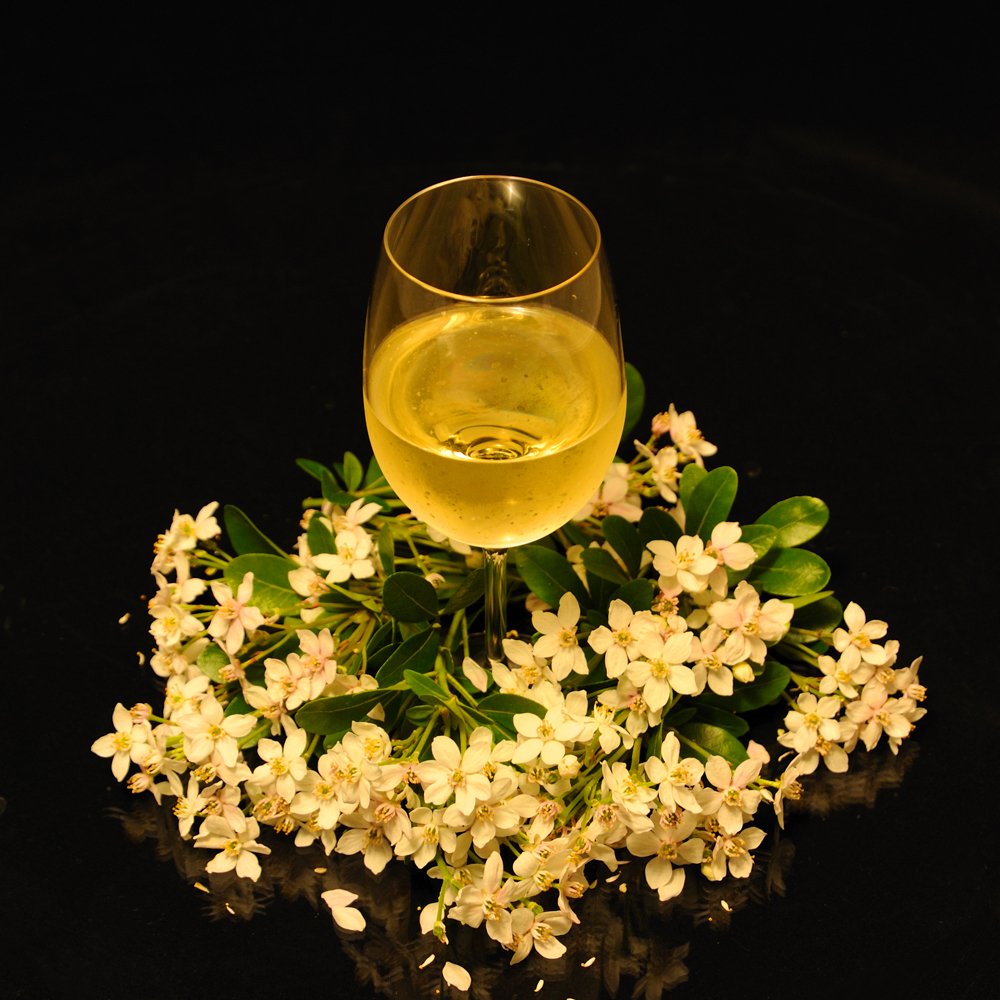
Sauvignon Blanc is one of the oldest cultivated grape varieties, and today it is the world’s second most popular white grape variety, after Chardonnay.
The wine it produces is light, refreshing, and naturally high in acidity, with a distinctive and instantly recognizable aroma: a whole bouquet of green notes—green bell pepper, gooseberry, blackcurrant leaves, freshly cut grass—along with tropical fruit and white flowers.
Sauvignon Blanc is generally meant to be drunk young, and with relatively few exceptions, aging does it no favors. The wines are usually dry, although Sauvignon Blanc is also an important component of the famous sweet wines of Sauternes and Barsac.
The homeland of Sauvignon Blanc, like that of many other internationally important grape varieties, is France. Preliminary genetic research suggests that Sauvignon Blanc is descended from Savagnin, a genetically highly unstable variety. It hasn’t been particularly popular with winemakers for precisely that reason, but it has nevertheless given rise to a remarkable number of important grape varieties.
Sauvignon Blanc established its main roots in the Loire Valley and Bordeaux. The first written references to the variety date back to the 16th century.
The name “Sauvignon” most likely comes from the French sauvage, meaning “wild”—probably a reference to the relatively “wild,” non-distinctive vines from which the variety is thought to have originated.
Since we’re talking about names, let’s mention not only Sauvignon Blanc’s ancestors, but also its descendants. If you’ve ever wondered what, apart from the word Sauvignon, connects Sauvignon Blanc—one of the lightest white varieties—with Cabernet Sauvignon, one of the most powerful red varieties, the answer is simple: they are very close relatives indeed. Cabernet Sauvignon is the offspring of Sauvignon Blanc and Cabernet Franc, and its name is essentially a combination of the names of its parents.
Bordeaux and the Loire Valley have been growing Sauvignon Blanc for centuries.
The Loire specialized in varietal Sauvignon Blanc. Its cold, mineral-driven Sancerre and smoky Pouilly-Fumé have long been highly prized by French and European wine lovers. Parisians in particular valued the crisp, icy wines of the Upper Loire and considered the region their own vineyard on the doorstep of the capital.
Bordeaux, which has traditionally favored blends over varietal wines, includes Sauvignon Blanc among the four varieties permitted for Bordeaux white wines. It is also used as a complementary component alongside Sémillon in the famous sweet botrytized wines of Sauternes and Barsac.
The wines of the Loire and Bordeaux have always been appreciated by connoisseurs. But Sauvignon Blanc became a truly global variety only in the 1980s, when New Zealand decided to shake up its wine industry and entered the international market with a completely new style of Sauvignon Blanc: bright, intensely aromatic, floral, fruity, and instantly recognizable. The worldwide success of New Zealand Sauvignon Blanc, in turn, helped trigger a global Sauvignon Blanc boom.
For winemakers, Sauvignon Blanc turned out to be a rather wonderful gift. The wine is easy to drink and has a highly recognizable aroma, which makes it attractive to consumers. The variety is also highly productive. Most Sauvignon Blanc doesn’t require aging. And much of it is fermented in neutral vessels, meaning there is no need to invest in expensive oak barrels. Since the wine is intended to be consumed young, Sauvignon Blanc is also ideally suited to screw-cap closures. They eliminate the expense of expensive natural corks and reduce the risk of cork taint. I talk more about the advantages and problems of different wine bottle closures in the article “From Filling to Closure: Corks and Bottles.” So the production cost of Sauvignon Blanc can be lower than that of many other varieties, while demand remains high. And that’s good news for consumers too. All else being equal, a bottle of good-quality Sauvignon Blanc costs considerably less than, say, a bottle of good Cabernet Sauvignon. And that, of course, is another important reason for Sauvignon Blanc’s popularity.
The aroma of Sauvignon Blanc is highly distinctive, unlike, say, Chardonnay. So it’s hardly surprising that the basic chemistry behind that aroma was one of the first to be studied. And let me emphasize basic. The full chemistry of wine aroma is vastly more complicated.
The aroma of Sauvignon Blanc is built around two major components: green aromas—gooseberry, green bell pepper, nettle, freshly cut grass, blackcurrant leaves—and tropical fruit aromas, particularly grapefruit and passion fruit. There is also a characteristic boxwood aroma, often rather unflatteringly described as smelling like cat urine. So, technically speaking, some Sauvignon Blancs could be described as “a gooseberry bush visited by cats.” But don’t let that description put you off. It’s really not nearly as alarming as it sounds. The balance between these two major aromatic groups depends on terroir, and particularly on whether the vines grow in a cool or warm climate.
The green aromas are associated with the presence of methoxypyrazines in the wine. Significant amounts of methoxypyrazines are produced in genetically related varieties—Sauvignon Blanc and Cabernet Franc—as well as in their offspring, including Cabernet Sauvignon, Merlot, Carmenère, and Sémillon. The concentration of methoxypyrazines in the grapes depends on a whole range of factors, but climate is the most important one. High temperatures and intense sunlight break methoxypyrazines down. That’s why Sauvignon Blanc grown in cool climates—such as its native France or New Zealand—tends to have a pronounced green character. In Sauvignon Blanc from warmer regions, California for example, those green notes become much less pronounced and can disappear almost entirely.
Other factors matter as well. For example, vines growing in well-drained soils, or receiving less irrigation, tend to accumulate lower concentrations of methoxypyrazines than vines with greater access to water.
The aromas of tropical fruit and boxwood are largely the work of thiols.
Three thiols are particularly important in Sauvignon Blanc:
3MH, or 3-sulfanylhexan-1-ol, contributes aromas of grapefruit, passion fruit, and guava.
3MHA, or 3-sulfanylhexyl acetate, is responsible for sweet, intensely aromatic passion-fruit notes.
And 4MMP, or 4-mercapto-4-methylpentan-2-one, contributes that distinctive boxwood character.
Unlike methoxypyrazines, thiols aren’t produced directly by the grapevine. Instead, the yeast produces them from precursor compounds during fermentation. The amount of these precursors depends on factors such as climate—the warmer the climate, generally, the more precursors the grapes contain—as well as the particular vine clone. How efficiently the yeast converts those precursors into aromatic thiols depends on winemaking techniques and a whole collection of other factors that scientists still don’t completely understand. But, on average, grapes from warmer regions tend to produce more pronounced tropical-fruit aromas.
So, in Sauvignon Blanc from cooler regions—such as Sancerre and Pouilly-Fumé, the variety’s homeland—green aromas tend to dominate. In warmer regions, such as California, tropical fruit becomes much more prominent. And New Zealand Sauvignon Blanc famously combines both sides of the spectrum.
There is one important thing to remember, though: aroma compounds aren’t the only thing determining how the wine tastes.
In an excessively warm climate, Sauvignon Blanc loses acidity—the very thing that gives it its freshness—and the wine can become dull and flat. Higher sugar levels, another consequence of excessive heat, also mean higher alcohol, which isn’t necessarily a good thing for a variety whose appeal largely comes from its light, refreshing character.
Overall, Sauvignon Blanc is fundamentally a cool-climate grape. Too much heat does it no favors.
On the whole, the winemaking techniques used for Sauvignon Blanc are relatively straightforward. The wine is usually fermented in neutral vessels, most commonly stainless steel, at relatively low temperatures in order to preserve its pronounced floral and fruity aromas. There are nuances, of course. For example, Loire winemakers typically ferment Sauvignon Blanc at around 16–18°C. This slightly reduces the floral and fruity component while enhancing the wine’s mineral character. New Zealand winemakers tend to ferment at lower temperatures, which significantly intensifies the floral and tropical-fruit aromas while reducing the mineral component.
Fermentation or aging in oak is relatively uncommon for varietal Sauvignon Blanc. The fairly assertive tannins from oak can overwhelm the delicate aromas for which Sauvignon Blanc is prized. Oak treatment became particularly popular in California, where winemakers were looking for ways to add richness and intensity to Sauvignon Blanc grown in a hot climate. It also helped make the wine more appealing to consumers accustomed to fuller, richer wines—such as oak-aged Chardonnay.
Let’s look at the best-known countries producing Sauvignon Blanc.
First of all, the birthplace of the variety: France.
The Loire Valley, more precisely the Upper Loire, specializes in varietal Sauvignon Blanc. In general, the Loire Valley is a huge and diverse wine region, and different parts of it have their own specializations. The terroir of the Upper Loire is actually closer to Northern Burgundy and Champagne than to the other parts of the Loire — Central and Lower Loire. The Upper Loire is primarily Sauvignon Blanc country, producing very distinctive wines — spicy, icy, cool, and intensely mineral. The most characteristic aromas are gooseberry, grapefruit, lime, flint, and smoke.
Five wine regions of the Upper Loire are known for their Sauvignon Blanc: Reuilly, Quincy, Menetou-Salon, Sancerre, and Pouilly-Fumé. The most famous — and deservedly so — are Sancerre and Pouilly-Fumé. Sancerre is located on the western bank of the river, where the vines grow on Kimmeridgian limestone. The wines are lively, textured, intensely mineral, with citrus notes. Across the river, Pouilly-Fumé grows its most important vines on limestone mixed with flint. Its wines are similar in style to Sancerre, but somewhat softer, with floral notes and a pronounced gunflint aroma.
Touraine, in the Central Loire, is also worth mentioning. Touraine is primarily famous for its Chenin Blanc, but its Sauvignon Blanc should not be overlooked either.
Interestingly, neighboring Northern Burgundy — whose signature white variety is Chardonnay, with some attention also paid to Aligoté — has a small region called Sauvignon de Saint-Bris. It grows Sauvignon Blanc that survived there from before the phylloxera epidemic. Its wines are stylistically similar to their Loire counterparts.
Of course, Bordeaux is famous primarily for its red wines, and dry whites account for only about 8% of total production. But that is no reason to ignore them — especially the regions of Graves and Pessac-Léognan, where white wines receive particular attention. Bordeaux has traditionally favored blends over varietal wines, and white wine is no exception.
The foundation of white Bordeaux is Sémillon, with Sauvignon Blanc as an essential addition and smaller amounts of Muscadelle. It is worth noting that the proportion of Sauvignon Blanc in white Bordeaux blends has increased significantly in recent years.
Since Sémillon — which makes up at least half of a typical white Bordeaux blend — responds beautifully to aging and pairs extremely well with oak, white Bordeaux is often successfully made using techniques such as lees aging and maturation in oak barrels. The resulting wines are rich, full-bodied, and aromatic, with notes of honeysuckle, white peaches, honey, tropical fruit, and boxwood.
Sweet white wines account for only about 3% of Bordeaux’s total production, but the sweet wines of Sauternes and Barsac, made from botrytized grapes and capable of aging for decades, are deservedly considered among the finest sweet wines in the world. Sémillon forms the foundation; Sauvignon Blanc contributes acidity and aroma. I talk in detail about Sauternes in the article “Sauternes: The Sweet Gold of Bordeaux.”
Even though the first Sauvignon Blanc vines were planted in New Zealand only in 1973, the country is quite reasonably considered the variety’s second home. New Zealand Sauvignon Blanc combines the floral and fruity intensity of New World wines with the sharp flavors and chalky acidity characteristic of Old World wines. Many people consider it the best Sauvignon Blanc in the world. In 1985, Sauvignon Blanc from Cloudy Bay Vineyards became internationally recognized as an outstanding wine. Today, Sauvignon Blanc and New Zealand are practically twin brothers. The two names have become inseparably linked in the minds of wine lovers. In 2023, Hawke’s Bay was officially designated the 12th Great Wine Capital of the World, joining places such as Bordeaux, Napa Valley, and Verona. As of 2025, Sauvignon Blanc accounted for 78% of all New Zealand wine production and 89% of the country’s wine exports.
New Zealand’s climate and soils allow the grapes to accumulate enough methoxypyrazines for the green character to remain clearly pronounced. At the same time, New Zealand is warm enough for Sauvignon Blanc to develop floral and tropical fruit aromas that are barely noticeable in Sauvignon Blancs from its much colder homeland. The result is a New Zealand Sauvignon Blanc that combines Old World and New World styles — and many people consider it the ideal expression of the variety.
After the first international successes of Sauvignon Blanc, New Zealand winemakers followed a remarkably consistent style for a long time, maintaining that instantly recognizable Marlborough Sauvignon Blanc profile. However, in recent years some winemakers, particularly those working at smaller wineries, have begun experimenting more actively. Some increase the amount of methoxypyrazines in the wine, making it even greener — occasionally to almost caricature-like levels.
Others use short periods of fermentation and maturation in oak barrels to give the wine greater complexity, although with delicate Sauvignon Blanc this is a rather risky business.
For more details about New Zealand’s wine regions and the particular characteristics of its Sauvignon Blanc, see the article “New Zealand Wine: History, Regions, Varieties and Styles.”
In Chile, Sauvignon Blanc is one of the leading white varieties, alongside Chardonnay.
The vines were brought over from France back in the 19th century. They were planted, cultivated, and made into wine — but the wine tasted somewhat strange, unlike typical Sauvignon Blanc. Chileans were not particularly surprised. This was hardly their first encounter with a mysterious grapevine identity crisis. It was only in the 1990s, when Chile seriously embarked on modernizing its wine industry, that they discovered they had been growing a mixture of Sauvignon Blanc and Sauvignonasse. Chileans, in general, have a remarkable talent for grapevine confusion. They had a very similar story with Carmenère, now the signature grape of Chilean winemaking. Once they figured things out and sorted out the vineyards, they started producing excellent Sauvignon Blanc — stylistically somewhere between Loire and New Zealand, but closer to the Loire. It is similarly bright and highly mineral, but somewhat more aromatic.
The regions specializing in Sauvignon Blanc are primarily Casablanca and San Antonio, both located relatively close to the ocean and well cooled by nighttime fogs and daytime breezes. It is also worth paying attention to the high-altitude Elqui Valley in the north of the country, where Sauvignon Blanc tends to be richer and creamier than in the rest of Chile. For more details about Chilean winemaking, see the article “Chilean Wine: Getting Better Every Year.”
Following the New Zealand Sauvignon Blanc phenomenon, neighboring Australia also developed a growing interest in the variety. Over the past 30 years, the area planted to Sauvignon Blanc has doubled, making it the country’s second most widely planted white variety after Chardonnay.
For the most part, Australia’s climate is simply too hot for Sauvignon Blanc. The wines can end up either dull, or excessively grassy when the grapes are picked underripe in an attempt to preserve the necessary acidity. However, the cooler regions — first and foremost Adelaide Hills, as well as Tasmania and the coolest parts of Victoria and New South Wales — produce excellent varietal Sauvignon Blanc in a New Zealand style, but shifted slightly more toward tropical fruit. These wines are light and refreshing, with aromas of green apples, lime, fresh grass, and tropical fruit, and with good structure.
The second key region after Adelaide Hills is Margaret River. Here, Sauvignon Blanc is often used in Bordeaux-style blends — ranging from light, refreshing wines dominated by lemon, to creamy, full-bodied wines dominated by tropical fruit, sometimes fermented or matured in oak.
South Africa also produces excellent Sauvignon Blanc in a style somewhere between the Loire and New Zealand — with pronounced minerality and vivid aromas of grapefruit, which is a particularly characteristic note in South African Sauvignon Blanc, along with lime, fresh grass, gooseberry, and passion fruit.
Most Sauvignon Blanc here is dry and fermented in stainless steel, although some producers experiment with oak.
Sauvignon Blanc is also used to make sweet wines from botrytized grapes.
And besides varietal wines, it is used in blends with Sémillon, Chardonnay, and Chenin Blanc.
In the United States, the main producer of Sauvignon Blanc is California. Until the late 1960s, Sauvignon Blanc was treated rather dismissively in California. And understandably so: the Californian climate is, on average, too warm for the variety. In 1968, the famous American winemaker Robert Mondavi, having received a rather good crop of Sauvignon Blanc from his grape growers, decided to make an unexpected move to improve the reputation of the variety. He made a Sauvignon Blanc aged in oak — Californians were already accustomed to oak-aged Chardonnay — and released it under the name Fumé Blanc, as an allusion to Pouilly-Fumé. The style caught on, and so did the name. In the United States, wines are traditionally identified by grape variety rather than by place of origin. Mondavi was also one of the people who helped popularize this approach. So Fumé Blanc almost became a name for the variety itself. In reality, the name is purely commercial: winemakers can choose whether to call their wine Fumé Blanc or Sauvignon Blanc. And while Fumé Blanc was originally more commonly used for oak-aged Sauvignon Blanc, today the name can also be applied to Sauvignon Blanc fermented in stainless steel.
The main California Sauvignon Blanc producers are Napa Valley and Sonoma. They make Sauvignon Blanc in two broad styles: fermented in stainless steel and fermented or matured in oak. Good examples of the first style are bright and refreshing, with dominant aromas of tropical fruit, guava, and lime, along with herbal notes. The second style is softer and creamier, with vanilla notes from the oak.
Today, good Sauvignon Blanc is also made in Washington and Oregon. Washington produces a style somewhere between Loire and New Zealand, with good minerality and acidity and dominant notes of fresh grass and green apples. Oregon Sauvignon Blanc tends to be more floral and citrus-driven.
There is also some decent Sauvignon Blanc produced in Ohio, although it is difficult to find outside the state.
Canada grows Sauvignon Blanc in the Niagara region and the Okanagan Valley.
In Europe, Sauvignon Blanc is also an important variety in the Spanish region of Rueda, where it is one of the leading white varieties alongside the local Verdejo; in Styria, Austria; Collio, Italy; as well as in Romania and Moldova.
Despite Sauvignon Blanc’s distinctive and highly recognizable character, its geography and winemaking techniques offer enough variety to find a wine for almost any taste and occasion.
Sauvignon Blanc is a young wine. In general, it is best consumed as young as possible — within a year, or two at most.
With age, the green notes gradually give way to, and eventually become dominated by, aromas of asparagus, which do not particularly improve the wine. You can find Sauvignon Blancs that remain good for five years with almost no loss of quality, but these are exceptions. The exception to the exception is the best Sauvignon Blancs from the cool Loire — Sancerre and Pouilly-Fumé. These wines can actually improve with age. But even here, we are generally talking about two or three years, not much more.
Sauvignon Blanc does not require decanting.
It is best served chilled to 7–12°C (45–55°F).
Sauvignon Blanc pairs beautifully with a wide range of foods — fish, seafood, sushi, white meat, young cheeses, all sorts of vegetables, and Asian cuisine.
But we can approach the pairing a little more thoughtfully.
Highly mineral Sauvignon Blanc with earthy notes, such as Sancerre or Sauvignon Blanc from Tasmania, works particularly well with simply prepared seafood, with minimal spices and sauces — crab, white fish, and fresh oysters.
It is also excellent with goat cheese, tomatoes, and dill — or a salad combining all three.
And this style of Sauvignon Blanc is probably the best choice for sushi and sashimi.
Sauvignon Blanc dominated by citrus notes, as in Bordeaux, Chile, and Australia, works well with fatty fish such as sardines, garlic shrimp, and roast chicken.
It pairs nicely with feta-type cheeses and vegetables such as artichokes, avocado, and olives.
It also works particularly well with Greek cuisine.
Sauvignon Blanc with a pronounced herbal character, typical of New Zealand and South Africa, is an excellent match for dishes prepared with mint, basil, cilantro, rosemary, parsley, or green peppers.
It also works beautifully with spicy Asian food.
And oak-aged Sauvignon Blanc is a good match for white meat, especially dishes with creamy sauces.
So choose the Sauvignon Blanc that suits you and your gastronomic preferences — and enjoy.
