


Video about wines of Greece on my YouTube channel.
For many, Greece evokes vivid images of wine’s ancient roots—amphoras, Dionysus, Bacchanalia, and a history steeped in the free flow of wine. Yet paradoxically, Greek wine often goes unnoticed in the modern world, rarely coming to mind when browsing a wine shop.
Greece is often regarded as the cradle of world winemaking and the progenitor of European viticulture. While the exact origins of Greek winemaking are lost in the mists of time, it is widely believed that viticulture reached Greece via Egypt and Phoenicia, both of which inherited it from the ancient winemaking traditions of the Caucasus and Mesopotamia. Greece embraced and refined the craft, spreading it across the Mediterranean. For over four thousand years—and perhaps as many as six—Greeks have been making wine, with some of the world’s oldest grape varieties still thriving on Greek soil. Yet, despite its rich heritage, Greece has struggled to achieve modern recognition as a producer of prestigious wines.
In ancient Greece, wine was as abundant as water, though its quality remains a mystery. The Greeks often mixed their wine with herbs, spices, and even seawater, suggesting it may not have been of the finest quality—or perhaps it simply reflected their penchant for culinary experimentation. Despite this, Greek wines were highly prized by the Romans, and during the Middle Ages, Northern Europeans paid premium prices for wines from the Aegean Islands. But it’s worth noting that, at the time, the range of available wines was limited.
Centuries of Turkish rule dealt a devastating blow to Greek viticulture, as wine consumption was heavily discouraged. While the Greeks continued to grow grapes and produce wine, they could not compete with the flourishing viticulture of France and Italy, where monastic traditions had carefully nurtured winemaking into an art form.
The landscape and climate of Greece pose significant challenges for quality viticulture. Summers are hot and dry, while autumn often brings early rains that can threaten the harvest. In many regions, powerful winds are so strong that vineyards require protective measures. As a result, the most suitable locations for vineyards are often on mountain slopes, which, while providing better conditions, are far more difficult to cultivate than flat terrain.
Despite these obstacles, Greek winemaking has persisted through the centuries. The 1980s marked the beginning of a modern renaissance in Greek viticulture, yielding increasingly impressive results. Interestingly, the economic crisis of 2008 became an unexpected turning point for Greek winemaking. With the collapse of the domestic wine market and the decline of exports to Eastern European countries, which had long favored Greek semi-sweet and sweet wines, producers were forced to adapt to the global wine market. A new generation of winemakers stepped up, seeking training in France and other renowned wine regions, and worked tirelessly to revolutionize Greek winemaking. Exotic offerings like Retsina were moved aside, and the focus shifted from sweet and semi-sweet wines to more globally appealing dry wines.
At first, Greek winemakers leaned toward cultivating international grape varieties like Syrah and Sauvignon Blanc. However, they quickly realized that even expertly crafted versions of these wines couldn’t effectively compete with their French or Italian counterparts in an already crowded market. This realization led them back to their roots: Greece’s extraordinary wealth of over 200 indigenous grape varieties. By embracing local grapes and blending traditional practices with modern winemaking technologies, Greece has established a renewed and distinctive viticulture tradition. Today, Greek wines are gaining increased recognition on the global stage, celebrated for their unique character and heritage.
The improvement in Greek wine quality over just a few years is remarkable. When I first visited Greece in 2017, I discovered some fantastic wines, but finding them required careful selection to avoid disappointment. By the time I returned in 2021, the difference was striking. I didn’t encounter a single poor-quality wine. That’s not to say every wine was exceptional—that would be unrealistic in any country—but the overall quality of everyday table wines had improved dramatically, making it much easier to enjoy a good bottle without extensive searching.
Let’s explore Greek wine laws and how they’re reflected on labels.
Greece follows EU wine regulations, which play a significant role in how wine information is presented to consumers. For a deeper dive into these regulations and how they apply across Europe, check out my article “Learn to Read Labels: Europe“.
In summary, Greek wines, like those in the rest of the EU, are classified into two main categories based on geographical identification. The first category is table wine (or simply “wine“), which does not indicate a specific geographical origin. The second category includes wines with geographical indications, further divided into two groups: Protected Geographical Indication (PGI) and Protected Designation of Origin (PDO).

Greek wine laws are heavily inspired by French regulations, with categories essentially mirroring French terms. This influence is why many Greek wine labels include French translations. For instance, this bottle purchased in Greece features the wine category and other details in Greek on the front label, while the back label provides the category in French.
Wines exported to the USA typically display categories in Greek and English or sometimes exclusively in English. For example, this bottle of Retsina, bought in the USA, lists all label information in English for accessibility.
Additionally, some Greek wine labels, like this Nemea bottle purchased in Greece, include optional details in English, even when not legally required. This is particularly common for globally recognized producers, such as Papaioannou—one of Greece’s top winemakers. Including English descriptions makes the labels more tourist-friendly, even for bottles intended for the local market, enhancing their appeal to an international audience.
As I discussed in my article on European wine laws, while the EU provides overarching regulations, each country incorporates its own unique characteristics. Greece is no exception, offering distinct classifications that reflect its rich winemaking traditions. Notably, Greece has two specific PDO (Protected Designation of Origin) categories and two PGI (Protected Geographical Indication) categories.

PDO Categories
First PDO: Oenoi Onomasias Proelefseos Elenhomeni (OPE)
Also referred to as Appellation d’Origine Contrôlée (AOC) or Appellation d’Origine Protégée (AOP), this category is reserved for regions historically recognized for producing high-quality sweet wines. These wines are primarily crafted from the Muscat (a white grape) and Mavrodaphne (a red grape) varieties.
The question of whether Greeks have a sweet tooth is a curious one. A prominent winemaker from Crete once told me that they don’t, and the enduring popularity of retsina—a notably dry and distinct wine—seems to support this claim. However, for much of the 20th century, sweet and semi-sweet wines enjoyed enormous popularity in Eastern Europe, a key export market for Greece. As a result, Greek winemakers produced significant quantities of these styles.
By the 1970s, when the modern Greek wine law system was established, sweet wines were a source of national pride. To honor this tradition, Greece created a dedicated PDO specifically for sweet wines, encompassing eight regions. While the focus in recent years has shifted toward dry wines, this PDO still exists today, and it now includes some dry wines as well.
For example, this red wine from Nemea 2010 falls under this PDO category, but it is dry, showcasing how the designation has evolved over time..
Second PDO Category: Oenoi Onomasias Proelefseos Anoteras Poiotitas (OPAP)
Also known as Appellation d’Origine de Qualité Supérieure, this category encompasses wines that fall outside the scope of the OPE classification. It primarily includes high-quality dry wines of any color, though sparkling and sweet wines may also be produced under this designation.
For example, this 2004 red wine from Nemea is classified under the OPAP category, demonstrating its focus on premium quality and regional distinction.
Greek Protected Geographical Indication (PGI) Categories
First PGI Category: Topikos Oinos (TO)
Also referred to as Vins de Pays, this designation aligns with the EU PGI classification. It covers wines that do not meet the stricter requirements of OPAP but are still produced under established quality standards. This category is notable for its inclusion of wines made from non-native Greek grape varieties, offering a broader range of styles and innovation while maintaining a connection to Greek terroir.
Second PGI Category: Oenoi Onomasias Kata Paradosi (OKT) / Appellation Traditionnelle
This uniquely Greek category is reserved for a single wine: Retsina. Unlike other wine classifications, which require production to be tied to a specific region, OKT designates the entire country of Greece as the production area for Retsina. This means that only wine produced within Greece can legally bear the name “Retsina,” although similar wines are made elsewhere, such as in Australia, where they cannot use the protected name.
The creation of this category acknowledges Retsina as a distinct product that doesn’t fully conform to the standard definition of wine, which typically requires it to be made exclusively from fresh grapes. The addition of pine resin during production, a hallmark of Retsina, sets it apart and underscores its traditional Greek heritage.
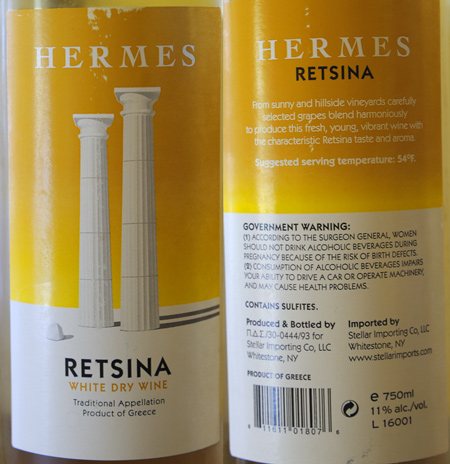
Retsina is the first wine that comes to mind when discussing Greek wines. No other country traditionally adds resin to wine—though I’m aware of the Australians who produce a similar version, they are merely imitators. The very name “Retsina” derives from the Greek word for “resin,” reflecting its defining ingredient.
This tradition originates from ancient times when wine was stored in clay vessels. To prevent air exchange and oxidation, the necks of these vessels were sealed with resin. The resin’s flavor initially arose as an unintended side effect of this storage method.
By the 3rd century AD, the Romans had invented the wooden wine barrel, which eliminated the need for fragile and cumbersome amphoras sealed with resin. However, the Greeks had already developed a fondness for the resin-infused taste and began deliberately adding resin to their wine.
Historical anecdotes suggest that adding resin to wine served another purpose: defiance. The Romans, who occupied Greece at the time, found the resin flavor unappealing and avoided drinking Retsina, leaving it for the Greeks. Centuries later, during the Ottoman occupation, wine consumption was discouraged, yet the Greeks steadfastly preserved their unique tradition of resin-infused wine.
Modern retsina is a dry white wine made by adding resin from the Aleppo pine (Pinus halepensis) during fermentation. As the wine ferments, it absorbs flavors from the resin, which is then removed through filtration. The primary grape varieties used in retsina production are Savatiano and Roditis. While white retsina remains the most common, a small amount of rosé retsina is also produced using the same process.
Though retsina is made throughout Greece, the Attica region—home to Athens—remains its primary production area, with the city serving as the largest consumer. Retsina is known for being simple, light, and affordable, making it a popular choice for everyday drinking. In the 19th century, Athens boasted around 6,000 tavernas where locals would leisurely enjoy jars of retsina, often made directly on-site. Grapes from local vineyards were brought to these tavernas, where the wine was made and consumed almost immediately.
Until the 1960s, retsina was rarely bottled or exported, remaining a beloved local drink. However, starting in the 1980s, some producers began to place greater emphasis on quality. Today, a bottle of retsina can be found not only in every Greek store but also around the world. For example, this particular bottle was purchased in Seattle.
High-quality retsina is a fascinating and enjoyable wine, though it remains a distinct and acquired taste. When made primarily with Savatiano, it offers a fresh, mineral-floral aroma, while if Roditis is the main grape, the wine takes on a more mineral-fruit fragrance. These aromas blend with the resin’s bitter, oily, and slightly salty notes, reminiscent of fino sherry. The unique flavor of retsina pairs beautifully with the bold, savory tastes of Greek cuisine. It is best served well-chilled, at a temperature of 7-9°C.
Greece boasts a repertoire of over 200 grape varieties, spread across the nation. While an exhaustive discussion is impractical, let’s delve into some key regions and varieties.
For the details about viniculture mainland Greece, from northern Macedonia down to the southern Peloponnese, click here.
For story of Santorini, the Aegean island renowned for its ancient vineyards and extraordinary viniculture, which dates back thousands of years, click here.
For story of Crete—the island where Greek viniculture originated and where its modern renaissance is especially remarkable – here.
