


Video about limoncello on my YouTube channel.
When life gives you lemons, make limoncello.
Limoncello is an Italian liqueur whose main ingredient couldn’t be more obvious—lemons. It proudly announces that fact right in its name.
The recipe itself is simple and minimalist: lemon zest is steeped in neutral grain spirit, then sweetened with sugar. Yet the result is so delightful that limoncello has become Italy’s second most popular liqueur after Campari.
It is produced primarily in Southern Italy, especially along the Sorrento and Amalfi Coasts, on the islands of Capri and Ischia, and also in Sardinia and Sicily. Which makes perfect sense—these are regions that have specialized in growing lemons for centuries.
Sorrento, Amalfi, and Capri all claim to be the birthplace of limoncello. Some insist that people in these regions have been making it for centuries, whether monks or fishermen, depending on which version of the story you hear. And, of course, homemade lemon liqueurs must have existed there for a very long time. It would be rather strange not to find some use for an abundance of lemons besides cooking. However, there is no written evidence that anything resembling modern limoncello existed before the early twentieth century.
The most fully developed origin story comes from Capri—and, interestingly, it’s also the only one with an official ending. At the beginning of the twentieth century, a respected Capri resident named Maria Antonia Farace grew lemons and oranges in her garden while running a small guesthouse. She welcomed her visitors with a homemade lemon liqueur prepared from her own family recipe. After the Second World War, either her grandson—or perhaps her nephew, depending on which account you believe—opened a bar on Capri near the famous Villa San Michele, once the home of Axel Munthe. The bar specialized in serving limoncello made according to his grandmother’s recipe. Then, in 1988, his son, Massimo Canale, registered the trademark and began producing and selling limoncello commercially.
So, as a commercial product, limoncello is actually a remarkably recent invention.
Its global success, however, came almost overnight. Today, limoncello can be found virtually anywhere in the world. Its largest markets are Italy, the United States, the United Kingdom, and mainland Europe.
The name limoncello itself is not protected by geographical indication, which means the liqueur can be produced anywhere in the world. Naturally, the vast majority still comes from Southern Italy, but places like California, where lemons are also grown in abundance, produce their own versions as well.
Limoncello made in the traditional production areas of Sorrento and the Amalfi Coast, however, has protected geographical status under the names Liquore di Limone di Sorrento PGI and Limoncello Costa d’Amalfi PGI. As a result, these liqueurs must comply with strict production regulations, and those regulations begin with the lemons themselves.
Which is hardly surprising, because the most important ingredient in limoncello is the right lemon.
You want lemons with thick, fragrant peels, plenty of juice, and a balanced flavor—not excessively acidic. Lemons have been cultivated in Italy since at least the second century AD, while Sorrento and the Amalfi Coast have been famous for their lemons since at least the seventh century.
The local maritime climate and fertile volcanic soils create ideal growing conditions, while the trees are traditionally protected from cold winter winds with woven straw mats.
The lemons of Sorrento belong to the Ovale di Sorrento ecotype, more commonly known simply as Sorrento lemons. Their best-known variety is Femminello Santa Teresa. These are medium-sized, oval lemons with moderately thick peels, a fragrant aroma, and a balanced sweet-and-tart flavor.
On the Amalfi Coast, the signature variety is Sfusato Amalfitano, often referred to simply as the Amalfi lemon. The Sfusato Amalfitano is one of Amalfi’s greatest sources of local pride. These lemons are exceptionally large, with thick, juicy peels packed with aromatic essential oils. They are intensely fragrant, remarkably juicy, and noticeably less acidic than most commercial lemons. In Amalfi, they’re commonly eaten fresh, sprinkled with either sugar or salt.
Both Sorrento and Amalfi lemons have had PGI status since 2001.
Although Italy remains the undisputed home of limoncello, California has become an important producer in its own right. Californian limoncello is typically made from the Eureka lemon, one of the world’s most common commercial varieties and the lemon you’ll find in almost any supermarket. Despite its Italian ancestry, the Eureka lemon differs significantly from its southern Italian relatives. It is more acidic, less sweet, and noticeably less aromatic, producing a limoncello with a distinctly different character.
Making limoncello is surprisingly simple.
The lemons are carefully peeled, removing only the thin outer yellow layer while avoiding the white pith underneath, which contributes unwanted bitterness.
Under the PGI regulations for Sorrento and Amalfi limoncello, only organically grown lemons may be used, since pesticides tend to accumulate in the peel. Naturally, the fruit must also be free of wax coatings. The regulations require at least 250 grams of whole lemons per liter of liqueur, although most producers use somewhere between 250 and 400 grams.
The zest is then steeped in neutral spirit—typically 95% grain alcohol—for anywhere from two to forty days. During this time, the alcohol extracts the essential oils and other aromatic compounds from the peel. The length of extraction determines the final character of the liqueur. A shorter infusion produces a brighter, fresher citrus aroma, while a longer one results in a deeper color and a more complex flavor profile.
Once the extraction is complete, the zest is filtered out, and sugar syrup is added. The liqueur is then left to rest for one or two months, allowing the flavors to stabilize.
According to the PGI regulations for both Sorrento and Amalfi no additives are permitted—no colorings, stabilizers, emulsifiers, flavorings, or anything else—with the sole exception of ascorbic acid, which may be used as an antioxidant.
Limoncello typically ranges from 25% to 32% alcohol by volume. Liquore di Limone di Sorrento must be at least 30% ABV, while Limoncello Costa d’Amalfi has a minimum strength of 25%. Sugar content usually falls between 200 and 350 grams per litre.
The defining characteristic of limoncello is its vivid lemon-peel aroma without the sharp acidity of lemon juice. That unmistakable citrus character comes primarily from the terpenes limonene and citral. Other terpenes—including β-pinene and γ-terpinene—contribute subtle herbal and woody notes, while linalool and geraniol add delicate hints of lavender and roses. Both the diversity and concentration of these compounds depend directly on the extraction time. A limoncello made with a short infusion will have a bright, clean, almost crystalline lemon aroma. A longer extraction produces a softer, richer, and more layered bouquet.
Although commercial limoncello is widely available, it remains very much a homemade drink in Italy.
Many Italian restaurants prepare their own house limoncello, and countless families make it at home. Offering a guest a small glass of homemade limoncello is as traditional a gesture of Italian hospitality as serving a cup of coffee. And a bottle of homemade limoncello makes a classic Christmas gift.
There are countless homemade recipes, of course. I’ve combined ideas from many of them into a version that I believe comes closest to the traditional limoncellos of Sorrento and the Amalfi Coast.
Let’s make limoncello.
Ingredients (makes approximately 2.5 liters)
-about 1 kilogram of lemons
-1 liter of 95% neutral grain spirit
-1.1 liters of water
-1.1 kilograms of white sugar
Let’s start with the lemons. If you happen to be in Sorrento or Amalfi during lemon season—and many Italians really do make the trip just to buy lemons—that’s the ideal choice. For most of us, however, that’s not exactly practical. Instead, look for lemons with thick, fragrant peels and plenty of juice. In the United States, Meyer lemons are an excellent option. They’re sweeter, less acidic, and considerably more aromatic than the ubiquitous Eureka variety. Organic lemons are preferable, primarily because they aren’t coated with wax for storage. Wax has absolutely no business ending up in your liqueur. You can scrub it off with hot water and a brush, of course, but that always feels like a rather questionable solution.
Wash the lemons thoroughly, then remove the zest, taking only the outer yellow layer and leaving the white pith behind. Place the zest in a glass container with a tightly fitting lid, pour in the alcohol, seal it, and leave it to infuse in a dark place at room temperature.
The infusion time depends entirely on what you’re after. If you want an almost colourless liqueur with an intense, straightforward citrus aroma, two days may be enough. If you’d rather have a beautifully golden limoncello with a softer, more complex bouquet, leave it for around forty days. A good place to start is somewhere in the middle—about twenty days. Once you’ve tasted your first batch, you can adjust the timing to match your own preferences.
When the infusion is complete, strain out the zest through a fine sieve or cheesecloth and discard it.
Now prepare the sugar syrup. Heat the water until it just reaches a simmer, add the sugar, and stir until completely dissolved. Let the syrup cool to room temperature. A one-to-one syrup is the traditional choice, but if you prefer a drier, less sweet limoncello, simply reduce the amount of sugar.
Finally, combine the syrup with the infused alcohol and stir thoroughly. Bottle the finished limoncello and let it rest for at least a week—longer if you can manage it. The extra time allows the flavors to marry and the liqueur to become smoother and more harmonious.
So, how is limoncello traditionally consumed?
In Italy, limoncello is served as a digestif—a drink meant to be enjoyed after a meal to aid digestion.
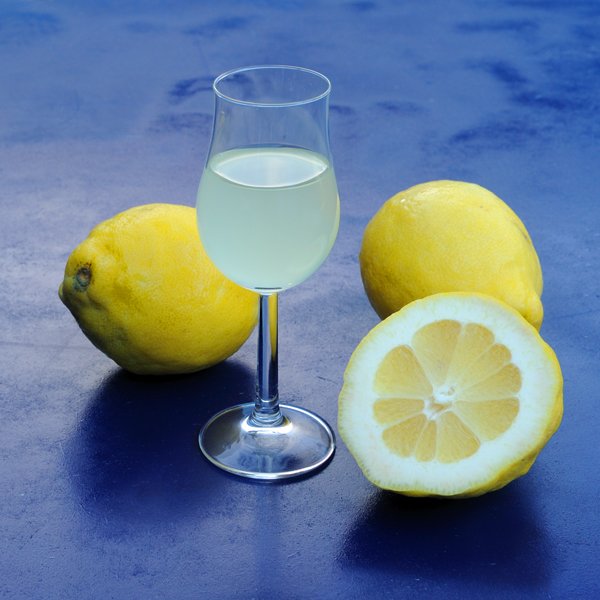
It is always served thoroughly chilled, straight from the freezer. The liqueur is poured into small shot glasses or tulip-shaped cordial glasses, which are often chilled in the freezer as well. The low temperature gives limoncello its characteristic silky viscosity while softening the remaining alcoholic bite.
Limoncello is also an extremely popular cocktail ingredient. It’s commonly used in spritzes and fizzes, in various martini-style cocktails, and in countless modern creations.
The liqueur is equally at home in the kitchen. It’s added to desserts such as ice cream, sorbets, tiramisu, and cheesecakes, and also finds its way into seafood dishes and salads.
As limoncello has grown in popularity around the world, an entire family of similar fruit liqueurs has appeared, some flavored with herbs and others made from completely different fruits.
For example:
Crema di Limoncello — a creamy version made with milk or cream.
Herbal Limoncello — infused with aromatic herbs such as thyme, rosemary, or lavender.
Arancello — made with orange zest instead of lemons.
Pompelmocello, or Pomecello — made from grapefruit.
Mandarincello — made with mandarin oranges.
Limecello — featuring lime zest.
Meloncello — made from melon.
Fragoncello — made from strawberries.
Raspicello — made from raspberries.
And the list goes on.
If you enjoy the bright, invigorating aroma of lemons, limoncello is well worth exploring. Have a chilled glass after dinner, shake it into a cocktail, or drizzle a splash over a bowl of ice cream. And if you happen to have access to wonderfully fragrant lemons, try making your own. It’s surprisingly simple, and by following the recipes of welcoming Italian families, you’ll end up with a bottle that captures a little taste of the Mediterranean in every glass.
